Pavement Markings, Signs, and Signals — Mississippi Driver's License Practice Test
95 questions in this topic · 30 drawn at random this round
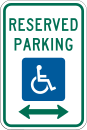
Who may park in a space marked with a handicapped parking sign?
Session Progress
This Mississippi Driver's License Pavement Markings, Signs, and Signals practice set has 95 practice questions based on the official exam materials, each with an instant explanation. You need 80% on the real Mississippi Driver's License knowledge test to pass.
Sample questions
Three questions from the Pavement Markings, Signs, and Signals bank with the correct answer and an explanation. The practice quiz above draws 30 questions at random from the same bank.
What is the driver's legal responsibility regarding pavement markings such as center lines, lane lines, and directional arrows?
- You must observe and comply with them — Correct answer
- You may ignore them if traffic is light
- They are only advisory and have no legal force
- They apply only to commercial vehicles
Explanation: Pavement markings—including center lines, lane lines, and directional arrows—are placed to help you drive safely, and you must observe and comply with them.
Handbook: Pavement Markings, Signs, and Signals — Pavement Markings
What does a broken yellow line between traffic lanes mean?
- Lanes move in opposite directions; you may cross only to pass when safe — Correct answer
- Both sides travel in the same direction and you may cross freely
- Passing is prohibited from either direction
- The lane is reserved for left turns only
Explanation: A broken yellow line separates traffic lanes moving in opposite directions. Crossing into the oncoming lane is permissible only for passing, and only when it is safe to pass.
Handbook: Pavement Markings, Signs, and Signals — Lane Lines, Center Lines, and Barrier Lines
What does a broken white line mean?
- Same-direction travel on both sides; you may cross to change lanes when safe — Correct answer
- Traffic on each side moves in opposite directions
- Crossing the line is always prohibited
- It marks the edge of the roadway
Explanation: A broken white line means travel in the same direction is permitted on both sides of the line. You may cross it to change lanes when it is safe to do so.
Handbook: Pavement Markings, Signs, and Signals — Lane Lines, Center Lines, and Barrier Lines